
I’ve written before about the walking artists collective I’m part of, Walking The Land, and their monthly First Friday Walks. These walks are fantastic – we have a theme, meet in a place (sometimes people join in remotely), and walk and discuss, with plenty of time for artistic response-making along the way. There are writers, painters, photographers, artists of all kinds, and it is a rich and generous group to be part of.
This month I co-led the walk through the grounds of Woodchester Mansion – a much more cultivated setting than usual. We took some time to explore our relationship with trees, as our non-human kin. Today, we were not concerned with the ‘why/’ or ‘what’s the point?’ of this – more, to see whether relating to trees in a more embodied, experiential way led us to think or feel in different ways than we might be used to.
We did a few short exercises to explore three facets of ‘relationship’ as an aid to potentially different ways of seeing, feeling and being with our fellow carbon-based lifeforms.
I list these below (as well as my responses to them) as an offering to anyone else who wants to have a go. All are very simple; all can be done relatively discretely if out in public spaces; all can be done perfectly well at home with a pot plant if that is all that’s available for you; all can be done in moments or be allowed to stretch beyond time; all invite a quietening and a stilling in contrast to our normally very active ways of being in the world.
For all of these exercises, I’d recommend spending a few moments grounding yourself in your environment first by paying attention to what your senses are telling you.
- Symbiosis.
It is true that we ae all, ultimately, alone in many ways – it is true also that we all exist in an inescapable net of shared mutual dependence. One of the most simple and striking facts about trees is that we, humans – in fact all mammals – and trees, literally cannot exist without each other. We breathe in oxygen – a waste product of the tree – and we breathe out carbon dioxide – which is the equivalent of oxygen to a tree. Without each other, we would suffocate.
To explore a sense of mutual dependency;
- Find a tree, and get as close to it as you possibly can, or feel comfortable with.
- Start breathing, and as you do, switch your awareness from your own breath to the two-way exchange – the tree’s in-breath mirroring your outbreath and vice versa
I shared breath with a huge Western Hemlock fir tree; a ridiculously tall grandparent of a tree. After a minute or two, I had a brief moment of unexplained anxiety. I found a perfect place to rest my hand and give me comfort, that echoed one of my favourite parts of the human body – the quadrata lumborum, deepest of back muscles – twin columns of perfect muscle rooted in the pelvis and reaching up either side of the spine to join the ribs. They allow us to sway but remain strong and upright, like trees in a storm. My gaze followed the direction of the muscles upwards, and I became aware of my body’s ‘tree language’ – my trunk, branching out, my twigfingers and toeroots, the florets and dendrites of the bronchioles and alveoli in my lungs.

My breath feels grubby today, a bit noxious, and it’s uncomfortable, until I remember that this is exactly what the tree needs. My breath is a treasure.
I’ve taken some scrap paper from work to make notes on, and on the back of what must be a handout from an unknown course are some lines on the nature of consciousness. Divorced from their original context, the unknown author tells me that:
‘Consciousness [is] the interface between our perception of the outside world as it is at this moment, and our perception of our internal world as it is at this moment. That is, the point where all that I know of my environment meets all that I know of my body state’.
I didn’t look for these words, they fell into my eyes from a clipboard – but on that moment, placing so much of my attention on my body state in the act of breathing with my chosen tree, they seem truly synchronous and stupendously profound.
- Reciprocity
Relationships, or at least healthy ones, involve a mutually acceptable level of give and take – though rarely an equal balancing of the two at one time – rather, it seems to be a dance, or a seesaw. We need to be comfortable with both giving and receiving in mutually acceptable ways. It seems there is a tendency in our times when it comes to natural resources to polarise ourselves; while much of our collective culture thoughtlessly, rapaciously, greedily takes; many of us individually seem assume responsibility in response – to take the guilt of the whole world’s greed upon ourselves, risking becoming paralysed in despair, feeling a need to be in a constant state of giving and to never feel at ease receiving.
To explore your own feelings and comfort around giving and receiving:
- Find a tree, or a plant and give it the gift of your attention. Really look at it. See its perfection, it’s detail. Marvel and wonder at this perfect miracle of a being and the sheer, chaotic, one in a million chance that has brought you both together via your various ancestral paths over the aeons to be here, together, now.
- And now, let your green kin give you the same gift of its attention. Allow it to see you, all of you – the beauty, the ragged bits, everything you have experienced and done and been. Through that gaze, see your own perfection and feel the rightness of being here, a natural creature amongst natural creatures, in a moment of total clarity and confidence.
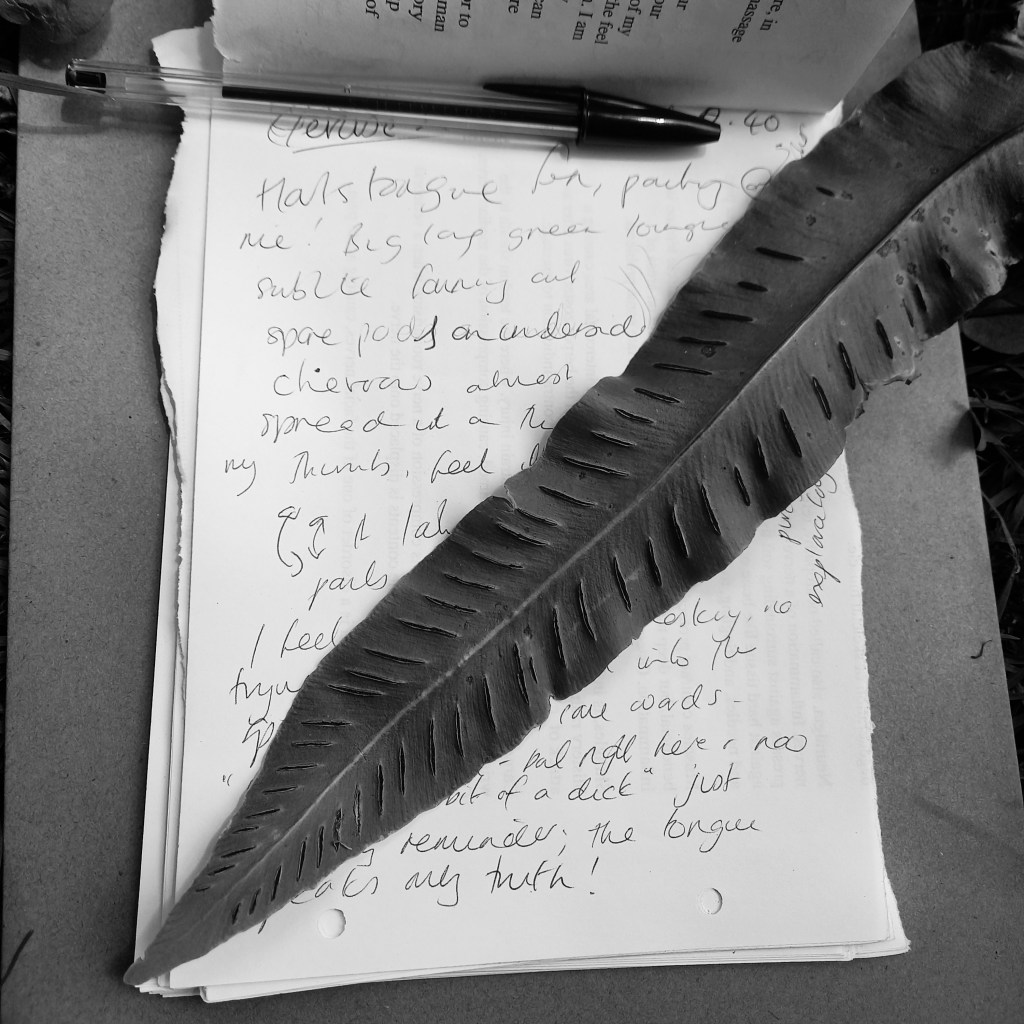
The minute I stop explaining the exercise and start looking around, a harts tongue fern leaps into my forevision. It is so green, and so vivid, it is cartoonish. The tip of its’ tongue seems to point right at me – right between the eyes – and almost beckons me to it; a sorcerer’s apprentice, the corner of Dr Strange’s sentient cape. I can’t refuse such a summons,
I spend some time looking at his beautiful, geometric, stone age form, this dinosaur of a plant, a living fossil. They used to tower over us, the ferns. I turn it over and look at the rich, chocolatey chevrons of the spore pods. I run my thumbnail down one and split it open, the spores making a dusty paste on the webbing between my thumb and forefinger. The more I look, the more I see – the fine lighter green tracery of veins, the flapping suitcase straps of the fronds, the rippled edges.
It looks right back at me, and sees me. Sees. Me. And I feel such a sense of relief, a burden falls from me, my shoulders drop and my face relaxes. Here, I can just wholly be myself – no masks, no trying, no constantly checking and managing and censoring myself. I do not resent having to do these things in the way that many do; but it is exhausting, and the daily effort makes me appreciate this moment of release and freedom from my depths.
Then, as if it were an everyday Laughing Jesus full of humour and compassion and mystery, it says to me:
you are amazing and unique and brilliant in your difference
even when it is a source of discomfort
there is no-one like you
and it is a gift
and you can be proud of this
and bask in the rich glory of it
but
and this is important
don’t let the awareness of your difference
become a license to be a dick
as you were soldier
keep up the good work
Those tongues speak an uncanny truth! I have a new respect for this fern. It feels okay to pick a leaf to take home and so I do, and I make a simple print as a reminder of this wisdom.

- Listening
We all want to be heard to one degree or another; and we all need to listen as much as we can. Like reciprocity, listening forms part of the relationship dance. Often when we listen – even to the extent of being encouraged to cultivate ‘active listening’ – it is a seeking, a very active act, and I feel it asks a lot of the one being encouraged to speak. Maybe too much sometimes, for the gentler souls. This exercise explores a passive listening – one that maybe allows the gentler, subtler voices to be heard. Rather than actively straining to seek a communication, we can relax, take our ease, see what voices arise and in what form.
To cultivate a passive listening:
- Find a plant to work with, and settle down comfortably with it – as if it were an old friend you’ve known for years.
- Allow your attention to soften. You are not here to prime your antennae, to scan the skies, to strain every sense and fibre. Here and now, you are here to see what comes, without preconception or assumption. It might be something, or it might be nothing. Become aware of the fleeting; the ghostly, the ephemeral; the incongruous.
- Try and switch off your intellectual capacities. You don’t need to interrogate, or interpret, or search for meaning in what you hear. You just need to accept it for what it is, because it is fine as it is.
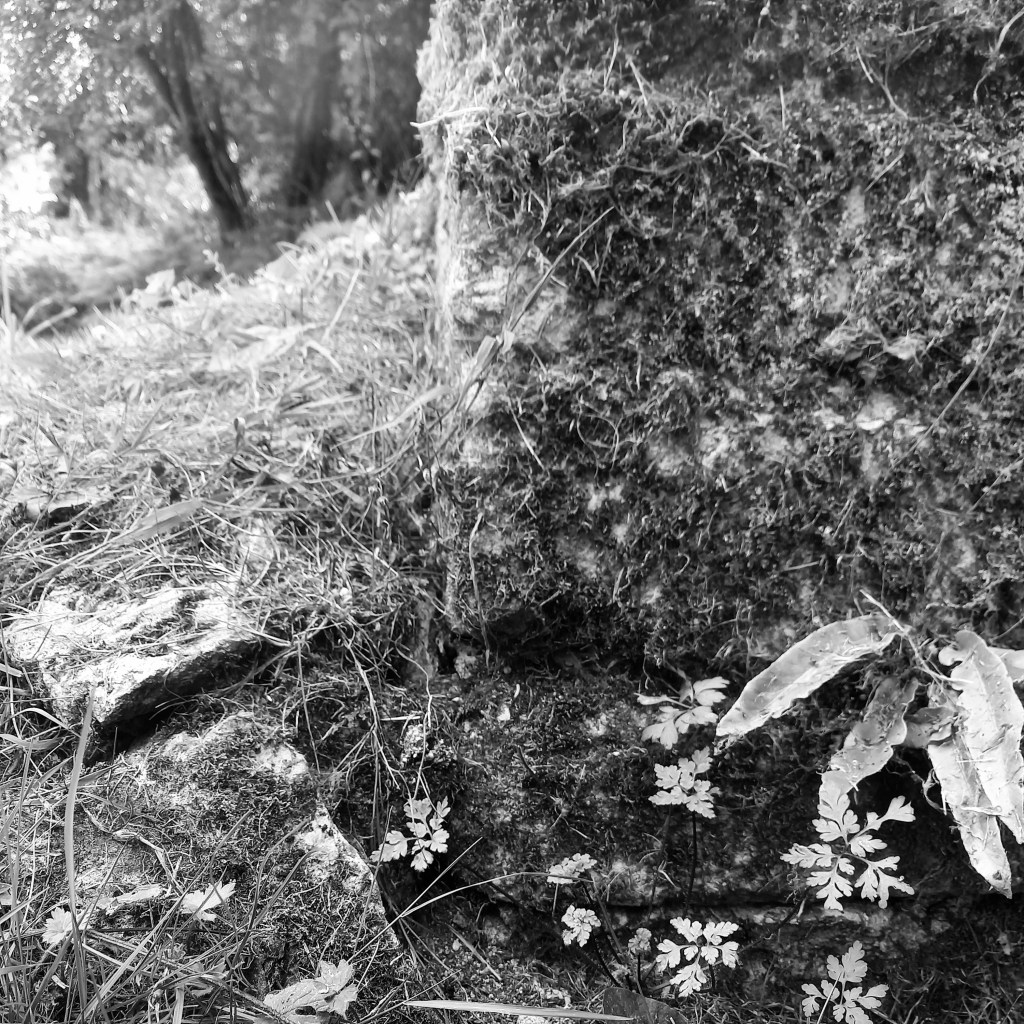
I find a lovely herb Robert, pungent and red-stemmed growing from a crack in the stone wall of an old cattle byre. I’ve allowed my eyes to scan my immediate horizon lazily, through hooded lids, until I hear a call ‘Bravesoul!’ I get up close and low down with this herb Robert, and have a huge desire to put a leafy frond in my right ear. Pushing aside a quick stab of ‘shouldn’ts’ I do exactly this.
How peaceful! Here is herb Robert, tucked cosily away in my ear like a snail in a shell, a hermit crab with scruffy legs dangling. I can feel its influence trickling through my ear canal and into my lymph system, following the line of my throat to the notch in my collarbone. I am hyperaware of the 3-dimensional inner-ness of my body – my interiority. When I take it out, I can hear the rushing of the sea – a static; a space; a void.
 TopoAnimus
I absolutely love this Charlotte! In 2021 I undertook a project, “learning to draw trees”, and a big part of that was about taking the opportunity to sit and be in communion with trees. I ended up turning it into a book: https://peakrill.com/products/learning-to-draw-trees-book-by-dan-sumption
LikeLike
Thanks Dan, glad you liked it. Trees are powerful entities for sure. I’m never quite sure whether they’re talking to us, or just reflecting us back to ourselves, but either way there is much to be learned.
LikeLiked by 1 person